Saturday, July 24, 2010

K, Dis One's For Gabi!
Oh hey there!
My sister Gabrielle has started her very first blog, which has inspired me to get back on here, after almost a month's unintentional hiatus. The truth is, she was the writer in the family first. She was doing it for as long as I can remember, perhaps as long as she can, too. Granted, I was making comic books and story boards for movies when I was a five-year old, but that always belonged more to the realm of drawing, in my mind. It was nothing like writing out a picture-less story, and being a true Author. I started doing it after she did, trying to be like her. Only I would start a story and never finish; I never had the stamina to finish one. But anyway, I've been inspired once again to keep it up, thanks to my sis.
It's been a fast-paced run through July. And frankly, that's okay by me. The puppet show has been going very well, and we've just finished out Salt Spring tour. We're back in Vic for a week, and then we hit the road once again!
I've developed a very interesting relationship with books, in the past year or so. You might even call it an intuitive one. I find that timing is important when it comes to reading. I won't touch a book, no matter how much of a gem it is, unless it or a subject it deals with has been on my mind for some time. Until then, I won't give it all the attention it deserves. Sometimes a book can put itself in my mind where it wasn't before, and then I'll see if it takes root. But it can't be forced. So if you recommend a book to me, please don't be offended if I turn it down or never bother to pick it up. No matter how good it is it probably just isn't the right time, so I won't be interested.
For instance, having read a couple of C.S. Lewis' books in the past few months, as well as some of his literary essays, I've been thinking more and more about his fiction. So in all likelihood I might end up reading his sci-fi series, and maybe the Chronicles of Narnia, one of these days. Reading his works has also led me in the direction of George MacDonald, a huge influence on Lewis, so I read the Princess and the Goblin. I might find my way back to him pretty soon as well, perhaps to read his adult fairy tale Phantastes. Ever since reading Peter Pan the play, I've been curious about the novel Barrie made out of it, so that is another one I want to get my hands on very soon. My point is, this is how my mind and appetite for reading works. I know what I want. And it might be more difficult, though not impossible, to come in from the outside and plant the desire for something entirely different. It all depends. Please don't stop recommending books, because there is no way that you can know whether I want to read it or not, but like I said, don't be offended if I turn it down. If it really is such a page-turner and just up my alley, then rest assured I will get to it in due time, and it's my loss alone for not reading it, right?
In the meantime, I'm on a mission to read more post-Tolkien fantasy, a whole world which I snubbed before I even gave it a chance. in grade 7 I read The Sword of Shannara by Terry Brooks, and assumed that most fantasy from the 60's onward was like that, so I didn't bother. I read The Eye of the World by Robert Jordan, and thought it was alright. I can't remember what it's about at all. It simply didn't leave an impression. BUT, those are only two writers in the genre, and there are many. Most of them probably are, to my tastes, crap, but I shouldn't spite the jewels for being rare. Currently I'm reading the Ursula K. Le Guin's novel A Wizard of Earthsea. She is highly acclaimed, and not just a New York Times bestseller, so I'm hopeful. I'll let you know how it goes. What's everyone else reading, these days?
Thursday, July 1, 2010
Happy Canada Day, Everyone!
And happy Dominion Day, to you, Andrew Cohen.
143 years and we still haven't quite moved out of our parents' house.
143 years and we still haven't quite moved out of our parents' house.
Tarantino's got nothing on Homer
I'd like to read to you a couple of passages from the Odyssey, Book 9:
'He leapt to his feet, lunged with his hands among my fellows, snatched up two of them like whelps and rapped their heads against the ground. The brains burst out from their skulls and were spattere over the cave's floor, while he broke them limb from limb, and supped off them to the last shred, eating ravenously like a mountain lion, everything--bowels and flesh and bones, even the marrow in the bones. We wept and raised out hands to Zeus in horror at this crime committed before our eyes: yet there was nothing we could do. Wherefore Cyclops, unhindered, filled his great gut with the human flesh, and washed it down with raw milk. Afterwards he stretched himself out across the cavern, among the flocks, and slept.'
And also, from Book 9:
'Some power from on high breathed into us all a mad courage, by whose strength they charged with the great spear and stabbed its sharp point right into [the Cyclops'] eye. I flung my weight upon it from above so that it bored home. As a shipbuilder's bit drills its timbers, steadily twirling by reason of the drag from the hide thong which his mates underneath pull to and fro alternately, so we held the burning pointed stake in his eye and spun it, till the boiling blood bubbled about its pillar of fire. Eyebrows, with eyelids shrivelled and stank in the blast of his consuming eyeball: yea, the very roots of the eye crackled into flame.'
Good old classical literature.
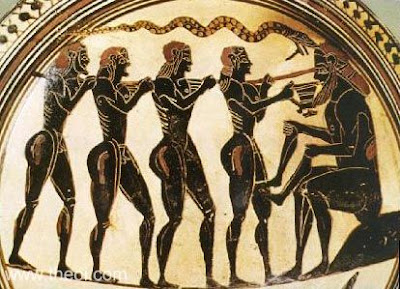
'He leapt to his feet, lunged with his hands among my fellows, snatched up two of them like whelps and rapped their heads against the ground. The brains burst out from their skulls and were spattere over the cave's floor, while he broke them limb from limb, and supped off them to the last shred, eating ravenously like a mountain lion, everything--bowels and flesh and bones, even the marrow in the bones. We wept and raised out hands to Zeus in horror at this crime committed before our eyes: yet there was nothing we could do. Wherefore Cyclops, unhindered, filled his great gut with the human flesh, and washed it down with raw milk. Afterwards he stretched himself out across the cavern, among the flocks, and slept.'
And also, from Book 9:
'Some power from on high breathed into us all a mad courage, by whose strength they charged with the great spear and stabbed its sharp point right into [the Cyclops'] eye. I flung my weight upon it from above so that it bored home. As a shipbuilder's bit drills its timbers, steadily twirling by reason of the drag from the hide thong which his mates underneath pull to and fro alternately, so we held the burning pointed stake in his eye and spun it, till the boiling blood bubbled about its pillar of fire. Eyebrows, with eyelids shrivelled and stank in the blast of his consuming eyeball: yea, the very roots of the eye crackled into flame.'
Good old classical literature.

Saturday, June 12, 2010
While I was reading Letters to a Young Poet, which Kayla recommended to me, I came across this passage:
"In this there is no measuring with time, a year doesn't matter, and ten years are nothing. Being an artist means: not numbering and counting, but ripening like a tree, which doesn't force its sap, and stands confidently in the storms of spring, not afraid that afterward summer may not come. It does come. But it comes only to those who are patient, who are there as if eternity lay before them, so unconcernedly silent and vast. I learn it every day of my life; learn it with pain I am grateful for: patience is everything!"
This summer has so far come to be a big lesson in patience. Patience in the knowledge that I will find a job, patience with my health, fitness and well-being, and patience with my artistic pursuits. I've become enthralled by the need to be efficient. If I'm not doing something with my time, I feel very anxious about it, and then depressed and greatly frustrated. Even if I am doing something, if it's not something my ego arbitrarily deems worthwhile, then it's as good as doing nothing. If it doesn't have a tangible result, then all is lost, it seems. I need to keep looking to this passage for a reminder that I don't have to do everything all at once. More importantly, the times where I feel inactive, something--an idea, a picture, a song, is in me and needs that time to bloom in my mind. The evenings I get home from work and I may accomplish nothing all evening, it's worth remembering that while my conscious self may not have done much, my unconscious might be working very hard, and is waiting for the right opportunity. It's worth remembering that any inspiration I get came to me not in spite of that seemingly endless wandering and floundering, but because of it. Nothing is a waste.
I've idolized the idea of maximizing my time, doing the most with it as possible; a distortion of the carpe diem mantra, I guess. Perhaps we're not meant to be that efficient. Stanislavski, who devoted his entire life to acting, likened himself to a prospector, who had to sift through tons of useless rocks just to gather a few pieces of gold. I think he found an abundance of it, but the important part is all of the time and energy he put into sifting through all the rocks. One can't get around that step.
A word I came across, also from reading Rilke, was fruitfulness. This word struck me instantly. I think this is what I've been working for, but I mistook it for its deceptively similar, utilitarian counterpart, productivity. Yes, they're synonymous, but I believe there is a difference, in our day and age at least. To me, fruitfulness implies fruit, which comes from an organic kind of growth that will only yield over time, with great patience and humility, after enduring great pain. Productivity is an Industrialist word, and it smacks of quotas in my mind. It implies efficiency, and economy. If a human being was a lightbulb, it would not be a very cost-efficient one. Yes, it can create light--and it is a marvelous light indeed!--but not without producing a lot of heat. The metaphor itself doesn't come close to it, because I don't think we're meant to be that way. We are from Nature, and Art is from Nature, so we really are more like a tree. That's why we live according to the seasons, and that's why there is a time for everything under the sun. (So for God's sake, we've got to stop believing that we are what we make! Our creations already have that covered.) Efficiency is something that I cannot satisfy right now. I think there's a reason why people say the "fruit of one's labours" more often than the "product of one's labours". It's got a far nicer ring to it, and it speaks of something that comes out of life and is life-giving. I believe this word is closer to Art, as well as Life. And that's what brings me back to the passage above. And that's why I've got to be patient. I will not yield anymore than my earth will allow.
Thursday, June 3, 2010
Confessions of an Armchair Anarchist
Hey everybody,
I haven't posted much of anything lately, and I don't really have too much on the boil at the moment. But that should change fairly soon. In the mean time, since I have no new material, I thought I'd share with you an ooold and silly entry from when I was 15, because it's just too amusing:
"I think laws are stupid. For as long as they exist people won't be able to continue in their evolution. Rid ourselves of laws and people will gradually become more self-reliant upon their potentiality for common sense. Things will seem chaotic at first I'm sure, but I believe the long-term effect will be better. Until then, we will be bound by laws; external agents that we look to rather than looking inward. Laws are like over-protective parents, doing more harm than good, since they are ultimately supressing the growth and development of the children (i.e. the subjects under which laws are implemented, a.k.a us). My two cents for today."
Liam Volke
October 13, 2004
Seemed like a good idea at the time, I guess.
Friday, May 28, 2010
I feel that I should explain a few things.
I often wonder why I even bother with Christianity anymore. I'm very aware of how much time I've put in writing about it on here, and frankly I would like to move on to other things again. But the fact of the matter is that it's been on my mind a lot lately, and it won't stop until I've followed this train of thought to its natural conclusion and it's done with me. All the same, I do wonder why I bother with it. For a long time I didn't, but it kept bobbing up every now and then throughout my teen life. Encountering figures like Desmond Tutu, C.S. Lewis, the mystics John of the Cross and Meister Eckhart, and especially people in my own life, showed me people for whom this faith had something real and true and beautiful, and it was a constant source of inspiration to them. Seeing them live this deeply within their faith made me admire them, and envy them their ability to access that through Christianity. It has long stopped doing that for me. For a while I wondered if their convictions, their love and compassion, was proof that Christianity did work. But then I realized that it was not the system, but the people themselves that inspired me. As I've mentioned here before, I have great faith in people who have faith. I also viewed these kind of people as an outsider. But I wanted to know what it was at the centre of their faith that inspired the joy and serenity they seem to possess. I wanted back into Christianity, but I felt it was too late, and I had moved on. I don't necessarily need it. Nonetheless, this religion has still been a subject of great fascination and frustration for me. So I should explain where I stand with it. Get comfortable, this is going to take a while.
As I grew older, I became more aware of different religions, a process that was accelerated in the post-9/11 era, where religion and diversity became a huge topic in schools and media. As I became more aware of different religions, I took an interest in them and studied them. The more I studied, the more I realised that there was something of God in each of them. Understanding their system of ethics, and the profound experiences that they were rooted in brought me to the conclusion that they too had a grasp on the sacred as much as my own faith tradition. This unhinging of my previous understanding of religion--the deep humanness of it--was liberating for me. I was someone who was raised in an environment of tolerance and open-mindedness. To discriminate against others for their religions never would have entered my mind, and yet I felt I needed some divine sanctioning for this ingrained attitude. My heart wanted to celebrate diversity, but my head wanted God's permission first. I believed in my newfound universalism, but I had no direct evidence for it. Yet seeing the way people of various traditions conducted their lives according to their faiths, reading the texts they regarded as holy, I was convinced of this idea. There were similar traits among each of them. How could a religion like Islam--that endorsed critical thought and social justice--be evil? How could a religion like Buddhism--that endorsed compassion for all beings, and offered the chance to transcend endless suffering--be godless? How could a man like the Dalai Lama not be holy, just because he didn't worship the God of Abraham and Isaac?
However, this liberation also brought with it a sense of inertia. I still felt I needed a way to express my own spirituality, but what were my options? To choose one road would be to exclude all the others in a way. I couldn't stand the idea of not making a choice, but the idea of defining myself also meant creating a border around me, which excludes more than it includes. You may ask, "why choose at all?" If the mind, as Comte-Sponville says, has no fatherland, then why the need to pretend it does? To choose did indeed feel futile, because I understood intellectually that the truth ultimately transcended any single path. God was greater than religion. Yet I still needed a way to that truth and I did not feel I could trust myself on my own to reach it.
For years I've been orbiting around Buddhism, but I can't make a decision about following it specifically for a few reasons, one of them being my fear that I would commit to it for all the wrong reasons. In some ways it felt more true to Buddhism not to officially convert to it, because otherwise it would simply be exchanging one parochial worldview for another. Again, perhaps I needn't make a choice. But a large part of me longs to actively express my spirituality, and to openly acknowledge the sacred in my every day life, something a secular lifestyle often overlooks.
Amid all this, Christianity hasn't completely lost its appeal. For all its baggage throughout history, even in spite of its narrow view seemingly built into the Bible, I've been drawn to it. I felt the ministry and teachings of Jesus of Nazareth has a great deal to offer to our contemporary world. This I cannot deny. I believe this is so because it is mirrored in other faiths. The problem with that was that I only really saw its value when I held it up to the alternatives. I could not put stock in Christianity until it was validated by other systems, so this meant I had other built-in standards by which I was measuring it. I think that because I've tried to view the Gospels through the lens of Eastern philosophy to make sense of it, I wondered if I belonged to that mindset, which is why I turn so often to Buddhism. The language of this faith tradition was always more accessible to my logic-saturated mind. It allowed me to think more. And yet, for whatever reason, my sights always wandered back to the images of cloistered cathedrals, humble monastic cells, bread and wine, lambs, blood --and crosses. Always the Cross loomed in my mind whether I wanted it there or not: a symbol of death turned inside out, into a symbol of selflessness and love. It is a dramatic and therefore unforgettable image, and therefore I could not forget it. This may be because I have been raised in a predominantly Christian context. To deny this cultural heritage would be apocryphal. But whatever the reason, I am drawn to it, like a big, horrific magnet.
This past Christmas, I read Karen Armstrong's book The Case For God, and my hope for religion--not just faith, but religion--was renewed. She showed me that it does have a place in human society, but only because she illustrated its original meaning. Religion, she argues, is not something you intellectually believe in, but something you do. It was a skill, a technique, similar to practicing scales on a piano, which could help someone improve and expand their spiritual life the more they did it. It was the way one carried out what one believed. The ritual in religion had potential to awaken the spirit of action and enlightenment. She also gave historical evidence of the same transcendent experience in all religions, eastern and western, so this put my mind to rest about that. That wasn't enough to make me consider returning to Christianity, however. It was a crucial moment, but not the end.
I tried going to church a few times over Lent, and while I wanted a spiritual community, I couldn't relate to the liturgical practices. I couldn't say the Apostle's Creed without feeling a knot in my stomach, knowing I didn't believe 95% of it. I believe in forgiveness, and I believe in God, (although in no form resembling the traditional bearded patriarch), and I believe that in all likelihood Jesus died under Pontius Pilate's governance, since this governor was a real historical person. Everything else I couldn't swallow. The biggest issue barring me from Christianity is its historicity. In our contemporary Darwinised world it is perfectly alright for Christians to believe that the story of Genesis is nothing but a creation myth. A lot of the supernatural aspects of the Old Testament are generally viewed as myth and metaphor to most Christians today, thankfully. Therein science and religion may coexist. The problem comes up with the stories surrounding the life of Christianity's protagonist. Can a person see the Virgin Birth, the various miracles Jesus performed, and the Resurrection, as metaphor rather than fact, and still be considered a Christian? To be a Christian, in the orthodox sense, meant that these things had to be accepted as things that actually occurred in history, even if the Fall, Noah's Ark, and the parting of the Red Sea did not. And even if the Virgin Birth and the miracles were debunked, the Resurrection surely had to be accepted as a real historical event in order to be a Christian. This was the event that everything Jesus' life lead up to, we are told. It was what the Christian argument hinged upon. This does not work for me as literal, so I decided I must not be a Christian.
Furthermore, I could not accept the doctrine of the Trinity, which sucked the humanity out of Jesus and injected him with divinity--all done centuries after his death. I believe he was a man, nothing more. Therefore, I must not be a Christian. I also knew that all of the documents in the New Testament were written decades after Jesus' life ended, and in all probability he never said most of the things he was quoted to have said. So I could never be certain what the original followers of Jesus actually said and did. Unable to reach the historical Jesus, I couldn't be sure either way if the Gospels had any validity. It troubled me that people called these books the Word of God, when they were selected out of a plethora of gospels that were floating around at the time. For example, why did the Gospel of Thomas get rejected from the canon? Why did the canon close at all? Why did Paul get so much stage time in the New Testament? This to me seemed like the texts were edited by individuals who had their own agenda to promote, and closing the canon for all time was a way for the Church to exert its power and authority. How could I call it the Word of God when I knew it was tampered with, not to mention penned by humans? I could make no final conclusions from looking at history, so the way was barred for me.
But that wasn't the end either. At the beginning of the summer I started reading a book called The Sins of Scripture by John Shelby Spong. Spong is a Bishop in the Episcopal Church of America. He is also a theologian and a Biblical scholar. In this book he basically says flat out that the Bible is not the Word of God, but a document of very human origins. He deconstructed the Bible, one argument at a time, showing how its books were the product of human insight at best, and aggressive nationalism at worst. He goes through the passages that promote anti-Semitism, child abuse, homophobia and misogyny, and says they must be jettisoned from the Bible. They are not Holy Writ so they have no reason to be there. He does the same with texts that promote a patriarchal order, including the image of God as Father, and even the texts that the Church uses today to defend its stance on birth control. To "be fruitful and multiply" Spong argues, may have had a place in a time when the Jewish tribe was small and relied on its progeny to survive, but now that the planet is groaning under the weight of overpopulation, birth control is now a moral necessity; the sacredness of life is being compromised by the unchecked quantity of it. The best way to view the Bible is as a Jewish Epic, like the Odyssey was for the Greeks, or the Mahabharata was for Hindus--not the final truth, but a way for a people to tell the story of their nation using the language they had, with all its power and limitations. Finally, Spong casts the light on Jesus not as a god, but a man. He is not God, Spong says. In all likelihood he was a person conceived out of wedlock (yes, a bastard child; hence using the story of the Virgin Birth to avoid the scandal). And in all likelihood he had a wife (there are many theories about Mary Magdalene being this person, and Spong thinks that there is text evidence for it). Not only that, but he may have even had female disciples, so his community was not a Boys Only club as it has become and been up until now. He probably did a lot to infuriate the orthodox Jewish authorities, and so he was crucified and died for it. That's it. The Bible is not the Word of God, it is a collection of books conceived by human minds and shaped by their limited knowledge. But knowing this, Spong argues it is still possible to be a Christian. He believes that even though none of the Gospels can be seen as historically accurate, they point toward a man with whom people had a profound experience and that the miracles and the Resurrection, are still viable symbols for today, even if they did not literally happen.
I read about this further in Spong's book This Hebrew Lord. Its argument was that Jesus must be viewed "through Hebrew eyes", and that most of the imagery we have inherited in Christianity has been removed from its original context, and therefore distorted. Obviously Jesus had an effect on the people around him which they could only express with the words they possessed. It is important to look at him in his original Jewish context to understand the things that were said about him. People called him 'Lord' and 'Son of God' because these were images and words pulled directly from Jewish scripture to describe the Jewish Messiah, a human. 'Lord' and 'Son of God were titles for a man, the descendant of King David, not a divine being who came down to visit us from Outside. Even if he wasn't literally the descendant of David, he acted in such a way that made people believe he was the Messiah. This was the only language they had to express the experience they had with him. Spong also argues that as long as the Bible is seen as a human document and not the Word of God, it is possible to be a Christian, because Jesus was a man who defied tribal barriers: instead of rising up to crush and scatter his enemies, he preached the idea of loving his enemies. He reached out to communities outside of his own, regardless of who they were. His message of love and compassion are what shine through the Gospels, though hidden beneath the political biases and limited language of their writers. His story, Spong says, was the turning point at which the Jewish epic was transformed into a universal epic, and that is why he is significant and worthy of following. That is why he was called Christ.
After reading his work, I've been able to look at these facts not with trepidation, but relief. Of course all of this information has existed before Spong came along, but the fact that it was admitted by a person of considerable authority in the Christian Church, a Bishop no less, gives me hope for this faith tradition. Indeed, Bible scholarship came into its own about two hundred years ago, and yet it so much of its discoveries do not reach laypeople. Not through the Church anyway. Church authorities view it as a threat to the status quo, a threat to certainty which they seem to think that regular people cannot grasp. So they repress it, while people curious enough find out anyway, from other sources less friendly to Christianity. People use this information to level attacks against Christianity, and what I find interesting here is that Spong uses it as a defense of Christianity, or at least what he believes it should be.
There is one more problem I haven't addressed though. Still unsure about how to enter any path without negating the others, I read something else Spong said:
"Is our only alternative then to seek to honor positive tradition in all religious systems, creating in the process a pantheon large enough to hold us all together, a religion of consensus where the edges are blurred and the divisions are papered over? Some traditions, like B'hai, seek to do that, and they do it with great integrity, but that pathway, while positive for many, does not seem to me to offer the best hope for either religious toleration or a religious future."
This was exactly how I was feeling.
"I propose, rather, a different route into what I think is our inevitable interfaith future. Each of us as participants in our own particular faith must journey into the very heart of the tradition that claims our loyalty. I, as a Christian, must plumb the depths and scale the heights of my own faith system. I must learn to separate the essence of Christianity from the compromises this religious system has made through history...We Christians must journey beyond these forced political divisions to the core of our faith and there allow ourselves to discover its essence, to enter its meaning and finally to transcend its limits. We do that, however, while still clinging to what we call our ultimate Truth and what we regard as our 'pearl of great price.' That must also be the pathway that every Jew, Muslim, Buddhist, Hindu and any other participant in any other religion of the world must walk."
Spong makes the case that Christianity is a way that points to the truth, and not the truth itself, and that eventually one must go beyond it. This made perfect sense to me, now. I think I could understand this because of my experience as an artist, and a person. We as humans deal with the concrete, the tangible, and physical, in order to reach the abstract, the intangible, and the spiritual. Great art is created by focusing on the specifics. That is what specificity is to acting choices, that is what imagery is to literature. We deal with particulars to reach the universal. Jesus spoke in the concrete language of symbols because that is how the human mind works. Tibetan Buddhism employs the same method, by focusing one's energy on mandalas. We can't tend to the soul without the body, which is something I think Jewish wisdom understands quite well. We can't reach God but through the physical, because that is what our minds can wrap themselves around. It is like in the Bhagavad Gita: Arjuna asks Krishna to reveal himself in his full glory, but to do that would blind Arjuna, so Krishna takes on a physical form while on earth. That is what religion is. Trying to be specific in spirituality as one is specific in art. Trying to put clothing on the ineffable. Of course, it gets to a point where the clothing must be shed, but until then, it's a necessity.
So that's where I now stand with religion in general, and Christianity in particular. It's a very complicated relationship, but one I feel strongly about. Spong is just one individual, but his ideas resonate with me quite deeply, as does Armstrong, and even Lewis. That being said I haven't reached a final conclusion, but this doesn't bother me anymore. I know my journey is not over, and it excites me. But all in all, after reading these authors, I feel it is now possible to enter this faith tradition if I so desire, let alone any tradition, without giving up my intellect and my skepticism.
Subscribe to:
Posts (Atom)